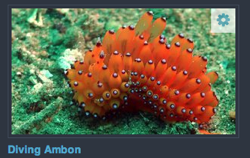
Diving the Moluccan Islands
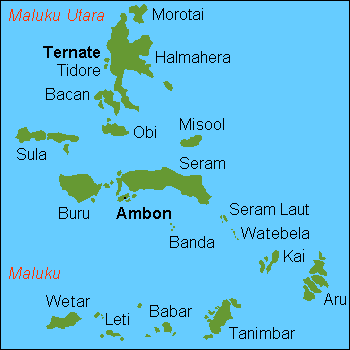
The Maluku Islands, also known as the Moluccan or Spice Islands are situated in the eastern half of Indonesia between Sulawesi to the west and West Papua to the east. The northern Moluccas (Maluku Utara) are formed by the island of Halmahera with the two small but historically important islands of Ternate und Tidore to west.
The central Moluccans are formed by the big island of Seram and the relatively small Ambon, the Maluku capital.
Further away to the southeast follow the Banda-Islands and the remote Kei-and Aru-Islands and in the south there are further small islands between Wetar and Tanimbar.
The central Moluccans are formed by the big island of Seram and the relatively small Ambon, the Maluku capital.
Further away to the southeast follow the Banda-Islands and the remote Kei-and Aru-Islands and in the south there are further small islands between Wetar and Tanimbar.
Civil War
After the proclamation of independence of Indonesia there were attempts on the Moluccas to secede from the newly founded state. However this movement of independence was defeated by the Indonesian army.
In 1999 civil war between Christians and Muslims broke out on Ambon. The bloody conflict lasted until 2002 when large groups of muslim fundamentalists (Jemaah Islamiyah and Laskar Jihad) who had infiltrated Maluku from East-Java suddenly left the islands in the wake of September 11. After the sudden disbanding of the fundamentalist fighters, the situation calmed down considerably. Today most of the destructions are repaired and reconstruction is in process.
In 1999 civil war between Christians and Muslims broke out on Ambon. The bloody conflict lasted until 2002 when large groups of muslim fundamentalists (Jemaah Islamiyah and Laskar Jihad) who had infiltrated Maluku from East-Java suddenly left the islands in the wake of September 11. After the sudden disbanding of the fundamentalist fighters, the situation calmed down considerably. Today most of the destructions are repaired and reconstruction is in process.
Maluku today
Today Maluku is visited by only a handful of tourists every year. This is mainly due to the lack of touristic infrastructure but also caused by the special climatic conditions of the Moluccans.
During the high season from June to September when most tourists come to Indonesia it is rainy season in Maluku. So definitely do not go there in summer.
However there are regional differences: The western coast of Halmahera and also the northern coast of Seram are usually dry in July/August. The big islands protect these areas from the rain.
Ambon is easy to reach - for Indonesian standards. There are daily direct flights from Jakarta. From other airports it is necessary to fly via Makassar (Ujung Pandang).
From there several scheduled flights go to Ambon every day.
Also the big Pelni-Ferries connect Ambon with all major ports in Indonesia. However this way of travelling is recommended only for visitors with a lot of time and a small budget.
During the high season from June to September when most tourists come to Indonesia it is rainy season in Maluku. So definitely do not go there in summer.
However there are regional differences: The western coast of Halmahera and also the northern coast of Seram are usually dry in July/August. The big islands protect these areas from the rain.
Ambon is easy to reach - for Indonesian standards. There are daily direct flights from Jakarta. From other airports it is necessary to fly via Makassar (Ujung Pandang).
From there several scheduled flights go to Ambon every day.
Also the big Pelni-Ferries connect Ambon with all major ports in Indonesia. However this way of travelling is recommended only for visitors with a lot of time and a small budget.
Diving in Ambon
Ambon is not only the hub and entry point for visiting Maluku, it is also an important diving destination on its own in Indonesia.
Looking through the fish identification books you will always find hints on Ambon. Also some fish species carry the name Ambon in their scientific names like the Ambon Scorpion fish, the Ambon Cardinal fish, the Ambon Emperor or the Ambon Pufferfish.
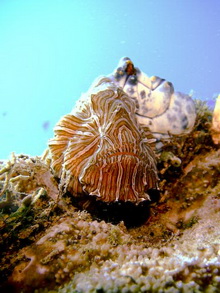
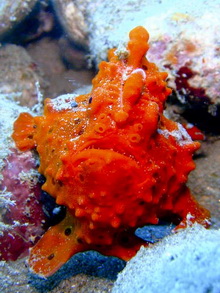
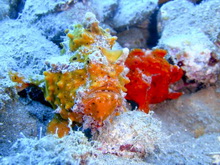
Also the recently (2009) discovered frogfish species should have been added to this list of special Ambon-species. The new species was called Psychedelic Frogfish (Histiophryne psychedelica) in the end. Nobody really understands why the responsible scientists chose this name and did not take the name of the place, the new fish was found or at least used the name of the person who discovered ist. It is a fact that the new species has until now only been discovered in Ambon (with the exception of a 17 years old specimen which came from Bali).
Especially this last discovery underlines the importance of Ambon as an important hotspot of biodiversity in Indonesia. Therefore it is no wonder that more and more underwater photographers and videographers come to Ambon in search of special critters under water.
The most interesting critter spots are on the northern shore of the huge Ambon Bay with a depth of around 600 m. The underwater topography of the dive sites is a change of sandy areas, rubble covered slopes and valleys in between with some coral bummies. There are very few dive sites with really nice coral growth (Batu Berdiri). Most sites are covered with soft corals or algae. The real muck can be found in Laha harbour (Laha I). Here weird things can be found between old tyres, metal and plastic sandals.
Looking through the fish identification books you will always find hints on Ambon. Also some fish species carry the name Ambon in their scientific names like the Ambon Scorpion fish, the Ambon Cardinal fish, the Ambon Emperor or the Ambon Pufferfish.
Also the recently (2009) discovered frogfish species should have been added to this list of special Ambon-species. The new species was called Psychedelic Frogfish (Histiophryne psychedelica) in the end. Nobody really understands why the responsible scientists chose this name and did not take the name of the place, the new fish was found or at least used the name of the person who discovered ist. It is a fact that the new species has until now only been discovered in Ambon (with the exception of a 17 years old specimen which came from Bali).
Especially this last discovery underlines the importance of Ambon as an important hotspot of biodiversity in Indonesia. Therefore it is no wonder that more and more underwater photographers and videographers come to Ambon in search of special critters under water.
The most interesting critter spots are on the northern shore of the huge Ambon Bay with a depth of around 600 m. The underwater topography of the dive sites is a change of sandy areas, rubble covered slopes and valleys in between with some coral bummies. There are very few dive sites with really nice coral growth (Batu Berdiri). Most sites are covered with soft corals or algae. The real muck can be found in Laha harbour (Laha I). Here weird things can be found between old tyres, metal and plastic sandals.
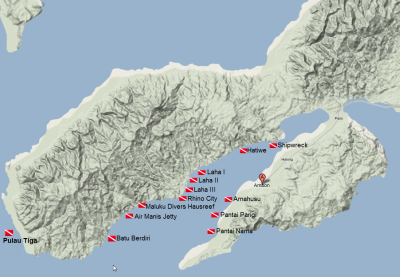
Our drift dives at Pulau Tiga were not bad, but not as good, that we would have asked for more of the same.
Outstanding however are the critter dive sites on the northern shores of Ambon Bay. Here you can find everything you find in Lembeh, however visibility (20 m) is much better and as there is no black sand in Ambon, all dive sites have much better light than in Lembeh. Another advantage is the lack of other divers. Critter Junkies and Dive Into Ambon are the only dive resorts which regularly visit these dive sites with their speed boats .
Another, Indonesian managed dive resort on the southern coast, Blue Rose, is too far away from the critter dive sites. They usually dive the reefs and walls in the south. During our 11 day diving holiday in Ambon we did not see any other dive boats. However deeply frustrated guests from Blue Rose came to Maluku Divers (now closed) complaining about the staff being unable or unwilling to take them out for diving.
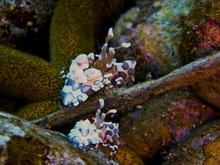
Critter lovers will enjoy diving Ambon and most animals on the wish-list of serious divers and uw photographers can be found here. With the exception of the Blue Ring Octopus, which did not show up while we were diving in Ambon, we found everything we were looking for.
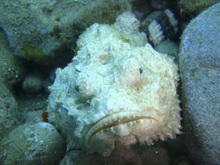
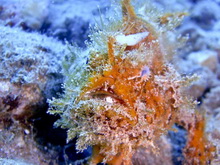
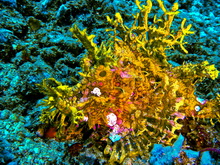
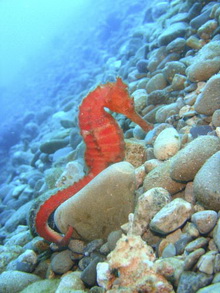
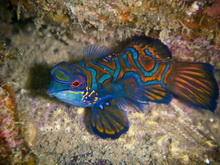
There were different species of Seahorses on many dives (H. kuda und H. histrix) and a lot of different frog fishes - including the new psychedelic species. There are a lot of Ghost Pipefish and there are two spots with Rhinopias (R. frondosa und R. eschmeyri). Also most members of the Scorpionfish-Family can be found in Ambon. Most noticeable are the many Devilfish variations (Inimicus didactylus) on sandy patches. Especially in the harbour of Laha many stonefish can be seen. Directly below the fishing boats Mandarin fish can be observed also during day time.
It is interesting that the Ambon Scorpionfish has not been sighted in Ambon for some years now. Funny enough you have to go to Lembeh, Maumere or Bali to see it.
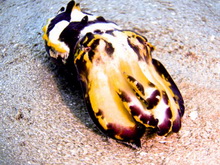
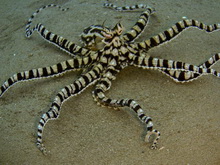
On sandy areas we always found Mimic Octopuses, Coconut Octopuses and Longarm Octopuses. During one dive we even watched mating Flamboyant Cuttlefish. During night dives Spanish Dancers and Boxer Crabs show up.
Have a look at the moon phases when you are planning a visit to Ambon: While there is usually very little current and excellent visibility in the bay in the time between full moon and new moon, conditions can change dramatically during full moon and new moon.
Then the current can be quite strong and visibility can decrease to mere five meters. Also all the resident animals hide and seek shelter behind and under stones and coral bummies and are extremely difficult to find.
Outstanding however are the critter dive sites on the northern shores of Ambon Bay. Here you can find everything you find in Lembeh, however visibility (20 m) is much better and as there is no black sand in Ambon, all dive sites have much better light than in Lembeh. Another advantage is the lack of other divers. Critter Junkies and Dive Into Ambon are the only dive resorts which regularly visit these dive sites with their speed boats .
Another, Indonesian managed dive resort on the southern coast, Blue Rose, is too far away from the critter dive sites. They usually dive the reefs and walls in the south. During our 11 day diving holiday in Ambon we did not see any other dive boats. However deeply frustrated guests from Blue Rose came to Maluku Divers (now closed) complaining about the staff being unable or unwilling to take them out for diving.
Critter lovers will enjoy diving Ambon and most animals on the wish-list of serious divers and uw photographers can be found here. With the exception of the Blue Ring Octopus, which did not show up while we were diving in Ambon, we found everything we were looking for.
There were different species of Seahorses on many dives (H. kuda und H. histrix) and a lot of different frog fishes - including the new psychedelic species. There are a lot of Ghost Pipefish and there are two spots with Rhinopias (R. frondosa und R. eschmeyri). Also most members of the Scorpionfish-Family can be found in Ambon. Most noticeable are the many Devilfish variations (Inimicus didactylus) on sandy patches. Especially in the harbour of Laha many stonefish can be seen. Directly below the fishing boats Mandarin fish can be observed also during day time.
It is interesting that the Ambon Scorpionfish has not been sighted in Ambon for some years now. Funny enough you have to go to Lembeh, Maumere or Bali to see it.
On sandy areas we always found Mimic Octopuses, Coconut Octopuses and Longarm Octopuses. During one dive we even watched mating Flamboyant Cuttlefish. During night dives Spanish Dancers and Boxer Crabs show up.
Have a look at the moon phases when you are planning a visit to Ambon: While there is usually very little current and excellent visibility in the bay in the time between full moon and new moon, conditions can change dramatically during full moon and new moon.
Then the current can be quite strong and visibility can decrease to mere five meters. Also all the resident animals hide and seek shelter behind and under stones and coral bummies and are extremely difficult to find.
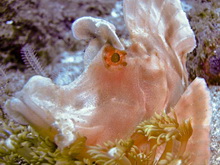
Dive centers in Ambon
Dive Into Ambon
Dive Into Ambon is the new star in the diver's sky of Ambon. The dive center opened in 2013 and nearly from the start had enthusiastic reports from guests.
The dive centre is situated on the premises of the Maluku Resort & Spa where most guests stay in decent double rooms or cottages.
Kaj Maney, the owner of Dive Into Ambon was chief-dive guide at Kungkungan Dive Resort in Lembeh and is also an excellent underwater videographer. Just have a look at his private website liquidguru.com!
The dive centre is situated on the premises of the Maluku Resort & Spa where most guests stay in decent double rooms or cottages.
Kaj Maney, the owner of Dive Into Ambon was chief-dive guide at Kungkungan Dive Resort in Lembeh and is also an excellent underwater videographer. Just have a look at his private website liquidguru.com!
Critter Junkies
Dive Bluemotion Ambon is the cheaper alternative to Dive Into Ambon. This dive shop is based in Lahar, very close to the best dive spots in Ambon Bay.
Recently they have changed their name into Divepoint Critter Junkies. If you want to dive with them you will have to stay in cheap hotels in the vicinity. The Critter Junkies will help you to find a place to stay.
Recently they have changed their name into Divepoint Critter Junkies. If you want to dive with them you will have to stay in cheap hotels in the vicinity. The Critter Junkies will help you to find a place to stay.
Blue Rose Divers
Cheap diving is also available at the Indonesian managed Blue Rose Divers at Santai Beach on the south coast of Ambon. The resort is situated close to the dive sites in the south with beautiful walls and reefs. The resort's speedboats also visit the dive sites in Ambon Bay.
However during our visit in April 2010 the resort was not catering for divers. Walk-in visitors were sent away. The staff was not able or unwilling to organize diving. So it might be better to contact them in advance to make sure, there is somebody at the resort who is able to organize the diving. Blue Rose divers might be the choice for people with a lot of time and not enough money to afford the more expensive Dive Into Ambon.
However during our visit in April 2010 the resort was not catering for divers. Walk-in visitors were sent away. The staff was not able or unwilling to organize diving. So it might be better to contact them in advance to make sure, there is somebody at the resort who is able to organize the diving. Blue Rose divers might be the choice for people with a lot of time and not enough money to afford the more expensive Dive Into Ambon.
Cape Paperu
When looking on the internet for resort based diving on Ambon Cape Paperu always pops up. Cape Paperu Resort however is not situated on Ambon. The resort is on the island of Saparua in the south of Ambon, about 75 minutes by boat from the harbour town of Tulehu. Tulehu can be reached by car and it takes an hour from the airport.
From Paperu nice coral reefs are in reach and further south at Nusa Laut there is the chance to see schooling fish and pelagics.
From Paperu nice coral reefs are in reach and further south at Nusa Laut there is the chance to see schooling fish and pelagics.
Diving in Halmahera
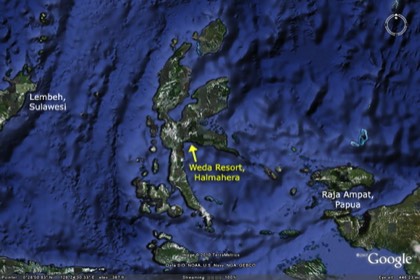
Since the end of 2010 there is also a new resort in the norther Moluccas. Weda Resort is situated on the eastern coast of Halmahera.
The fibre glass speedboats are 10 m long and specially designed and build for diving with 4 x 30 hp ultra low emission outboard engines, a toilet and 220 Volt power. Also the dive guides are well trained guys from Lembeh.
As far as the diving at the resort is concerned there are yet no reliable information available. On a diving trip from Raja Ampat to East Halmahera I visited some dive sites of the resort. We did not see anything very exciting compared to the dives we did in Raja Ampat. One highlight however was a trip to watch the Wallace's Bird of Paradise which can be seen in the proximity of the resort. Juli/August with strong winds from the south might not be the best time to go to Weda.
Prices:
Eur 150,-/day/person (including fullboard accommodation (incl. all meals, water, tea, coffee)and 3 boat dives + nonlimit unguided shore dives)
Eur 50,-/night/person (for non diving day and fullboard accommodation)
Eur 250,-/person. Single: Eur 400,- transfer cost Manado - Weda Resort 2 ways (incl. flights, car, speedboat)
Live Aboards
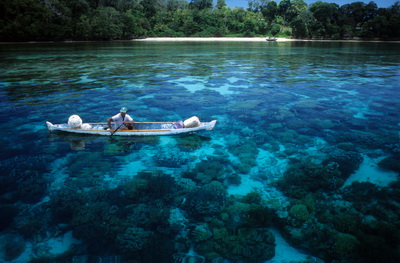
Most of the ships visit during these tours across the Banda Sea also the Banda Islands and Ambon. Some ships also stay in the region during the European summer and cruise around the northern coast of Seram or the southern and western coast of Halmahera where conditions are calm in July/August.
In case you are interested in such a tour it makes sense to have a closer look at the itineraries and websites of the following live aboards:
Amira
MV Amira is a very comfortable and spacious new live aboard. Like most other live aboards Amira is offering a Long Adventure and Snake Adventure in April/May and October. The Long Adventure normally includes southern Raja Ampat, Seram, the Banda Islands and Ambon. The Snake Adventure is the classical crossing of the Banda Sea from Ambon to Maumere on Flores. Amira is managed by Bruno Hopf, a very experienced Swiss cruise director.
Seahorse
The Seahorse is a big and very comfortable traditional pinisi schooner which has been bought by Kararu recently. The Seahorse offers cruises to destinations in the Moluccas in the season (April and October).
Ondina
The Ondina is managed by the very experienced Ricard Buxó and has been around the region for many years now. Also the Ondina passes through Maluku in April and October every year.
Temukira
MV Temukira is a middle sized live aboard with average standard. Temukira is one of the bigger ships of the Grand Komodo fleet. Grand Komodo has a good reputation and very competent dive guides.
MV Amira is a very comfortable and spacious new live aboard. Like most other live aboards Amira is offering a Long Adventure and Snake Adventure in April/May and October. The Long Adventure normally includes southern Raja Ampat, Seram, the Banda Islands and Ambon. The Snake Adventure is the classical crossing of the Banda Sea from Ambon to Maumere on Flores. Amira is managed by Bruno Hopf, a very experienced Swiss cruise director.
Seahorse
The Seahorse is a big and very comfortable traditional pinisi schooner which has been bought by Kararu recently. The Seahorse offers cruises to destinations in the Moluccas in the season (April and October).
Ondina
The Ondina is managed by the very experienced Ricard Buxó and has been around the region for many years now. Also the Ondina passes through Maluku in April and October every year.
Temukira
MV Temukira is a middle sized live aboard with average standard. Temukira is one of the bigger ships of the Grand Komodo fleet. Grand Komodo has a good reputation and very competent dive guides.
Underwater-Videos: Diving Maluku
My collection of underwater videos from Indonesia can be found on vimeo. The collection is sorted into albums containing only videos of a specific diving area. This is a very good opportunity to have a look at videos from other divers who have been in the area before.
You can see here what other divers have seen in Ambon before.
You can see here what other divers have seen in Ambon before.